A City Is Many Markets – And Data Can Make Brand Hypothesis Testing Easier
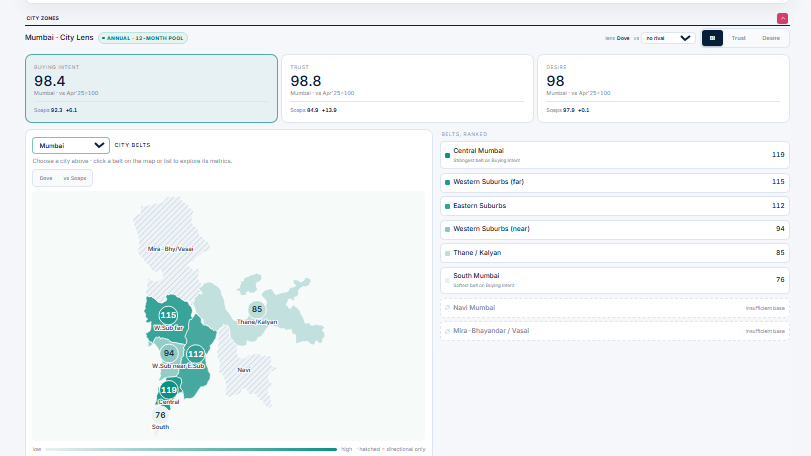
How brands can use city zones as real-world test markets
A brand may launch in one city, but it is rarely entering just one market. Within the same city, different zones can contain very different consumer segments: experimental buyers, trust-first audiences, premium seekers, value maximisers, category experts, first-time users, among others.
Knowing these differences can help brands design a city as a set of real-world test markets.
Each zone may differ in language, media consumption, price-value expectations, risk orientation and response to the same brand. Properly understood, one city can offer several distinct testing environments, potentially reducing the cost and complexity of wider testing.
Do not test the same marketing plan across an entire city. Test different market hypotheses across its zones.
A city-level score can tell a brand how it is performing overall. But such overviews often conceal the differences that matter most. Moderate Buying Intent across a city may actually include very strong Buying Intent in two zones, weak Brand Trust among non-users elsewhere, high Brand Desire among younger audiences, and lower relevance among more conservative consumers.
The city average gives the combined picture. A city-zone profile helps explain which audiences are contributing to that picture, and where the important differences lie.
That is where the multi-zone testing opportunity begins.
What makes a zone a distinct market?
A zone becomes commercially useful for testing when its consumers differ in ways that may require different brand actions.
Language may influence communication and media. Risk orientation may affect the need for reassurance, proof or trial. Price-value expectations may influence pack size or offers. Category familiarity may determine whether communication should educate, compare or persuade. Users, non-users and competitor users may each require a different approach.
Such detailed zone-level data is not always easily available. BuyingIntent.in therefore collects zone-based brand and audience data across 16 cities, helping marketers and advertisers move beyond digital targeting towards real-world micro-marketing and micro-advertising.
The point is not to create more segments for the sake of segmentation. It is to identify differences significant enough to justify different tests.
Design the zones around the hypothesis
Imagine selecting six zones across two cities whose audience profiles closely resemble six commercially important market profiles found elsewhere.
One zone might be used to test a smaller pack. Another could test a price or bundle. A third might test a regional-language campaign. Others could examine trial effectiveness, switching programmes, retail activation, benefit emphasis, preferred media or content format.
The possibilities are broad, but the test itself must remain disciplined.
A zone does not become a “control” simply because it has different data. A meaningful test needs a clear baseline and, where possible, comparable zones, matched conditions or an unchanged reference market against which the intervention can be judged.
The purpose is to understand what changed after a defined action—not simply to compare one zone with another.
Measure more than the immediate response
Online clicks, leads and sales funnels are useful, but they are not enough when the objective is to understand real-world brand movement.
A zone test can also examine changes in Buying Intent, Brand Trust, Brand Desire, consideration, switching openness and purchase barriers before a wider city, multi-city or national rollout.
The aim should not merely be to discover which zone performed best. It should be to identify which audience responded to which proposition, message or market action—and what may have driven that response.
That distinction matters. A zone test can reveal strong patterns and support better decisions, but it should not claim causation unless the test design genuinely allows it.
Scale the profile, not the postcode
A weak conclusion would be:
“This worked in this city.”
A more useful conclusion would be:
“This worked among bilingual, medium-risk, value-conscious consumers with high Brand Desire but moderate Brand Trust.”
That learning is more transferable because it is based on the audience profile, not merely the geography.
The next step is to identify other zones with similar commercially relevant profiles and test whether the same intervention works there too. Similarity makes the learning more portable; it does not guarantee that every market will behave identically.
That is why scaling should happen through profile matching and validation, not geographic assumption.
Buying Intent – the dashboard with city-zone data
In BuyingIntent.in, City Lens helps brands examine city zones and compare rival brands within them through Buying Intent, Brand Trust and Brand Desire, along with 400+ other parameters that help describe the brand, decipher its audiences and analyse its competition.
This can help marketing and consumer-insights teams identify where meaningful audience differences exist, which zones may be useful for testing, and what kinds of hypotheses may be worth examining.
So, do not treat a city as one launch market.
Properly read, its zones can become several real-world test markets—each helping a brand understand what to test, what to change, and what may be worth scaling next.