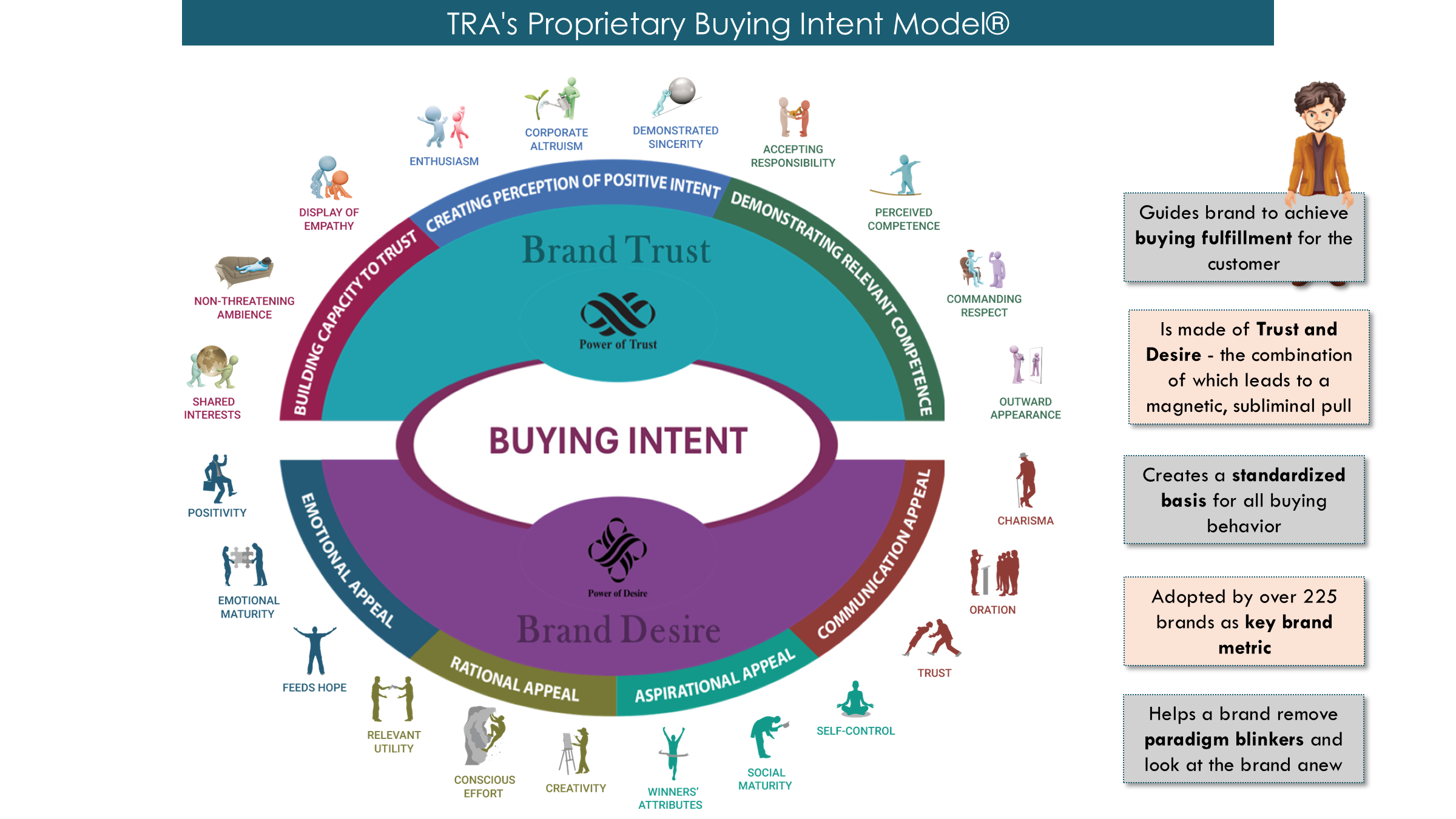

Buying Intent
121.30+53.50
Trust
63.80−24.70
Desire
154.20+108.40
The dot has moved up. So has consumer Buying Intent.
Buying Intent and Desire rose sharply over the year. Trust fell.

BII Use Cases
See how Consumer Buying Intent is changing: where, among whom, and what to do next.
Brands through the Buying Intent lens
We examine noteworthy developments we see across brands and categories, and use Buying Intent, Brand Trust and Brand Desire to understand what may be happening underneath.
Independent BII analyses. Brands featured are selected because we find the market development noteworthy; inclusion does not imply a client relationship.
Buying Intent and Desire rose sharply over the year. Trust fell.

Still #3, but now 4.8% behind #2, from 39.2% a year earlier.
 @10
@10Still #1, but its share of category Buying Intent fell from 69.1% to 61.3%.
More brand reads
710%in 16 months
 Birla Opus
| Brand | Then | Now | Change |
|---|---|---|---|
| Birla Opus | 13.90 | 112.80 | +710% |
 | 51.30* | 57.10 | +11% |
 | 415.50 | 377.40 | −9% |
 | 39.20 | 32.20 | −18% |
13.9 to 112.8 in 16 months, while Asian Paints and Nerolac fell.
Buying Intent 3.5 in July ’26, against 35.8 for Signature and 22.9 for Royal Stag.


These are individual market reads. The same BII framework can be used across a wider set of brand decisions.
Six moments when a brand has a decision to make, but the reason behind a change is not yet clear.
Is the change coming from the brand, the category, competitors, an audience or a market?
Which consumers show greater keenness to buy, and what sets them apart?
Which cities and zones need a different market approach?
What should the communication achieve, say and sound like today?
How can communication vary by market without fragmenting the brand?
What changed before, during and after, and among whom?
BII City Lens
A national average can hide where a brand is gaining relevance and where a different market action may be required. City Lens reads cities and zones through their consumer profiles and their relationship with the brand.
Illustrative BII interpretation rather than a live brand reading.
Changes the market action:
Changes the communication:
Micro-Marketing changes the market action. Micro-Advertising changes the communication within that action.
BII moves from understanding a change to the documents your teams can act on.
What changed, where, and among whom.
What to prioritise, strengthen or investigate.
Communication, target-group and market direction.
CMO, agency and market-team documents your teams use.
Built for CMOs, consumer-insights, brand, agency and regional market teams.
See how BII reads your brand, its audiences, markets, category and competitors.
BII complements internal research, brand data, revenue information and agency intelligence; it does not replace them.
 #1
#1 #2
#2